Creation tutorial · Updated November 14, 2026
Build a View.
Turn an idea into the 360° scenery around your Room. Follow one Maldives panorama through three tested model routes, with real images, native sizes, repairs and costs.
Start your own View
Clone the public project, open the folder in an agent that can generate images and run Python, and ask it to use the build-a-view skill. The host’s built-in image tool can make the initial base without an external API key; host usage limits still apply. High-resolution enhancement needs your selected provider’s API key.
git clone https://github.com/EnterLocus/locus-support.git
cd locus-supportUse the build-a-view skill to make a static full-sphere View of a place I describe. First show me the base panorama and a 360° preview where supported. Wait for me to accept the layout. Then offer models, native-size estimates, Standard or Batch processing, and an itemized cost plan before any paid enhancement.
There are two checkpoints: accept the base and its layout first; then choose the API model, credential reference, native-size estimate, cost plan and processing mode. Give an environment-variable name such as OPENAI_API_KEY or GEMINI_API_KEY, never a secret in chat. Approve each concrete paid submission, or explicitly authorize a listed full plan under a combined cap. A key or a planning budget alone is not approval.
A 360° preview depends on your host. If it cannot open one, ask for an available local interactive preview and perspective views. A flat image alone does not show what every direction looks like.
Use the defaults below: restore the whole low-resolution base, enhance six contextual faces, merge at actual native sampling density, then inspect every direction, join and pole. Start with no repairs and reserve up to two targeted outputs; extra attempts need their own scope and approval.
One original, three model routes
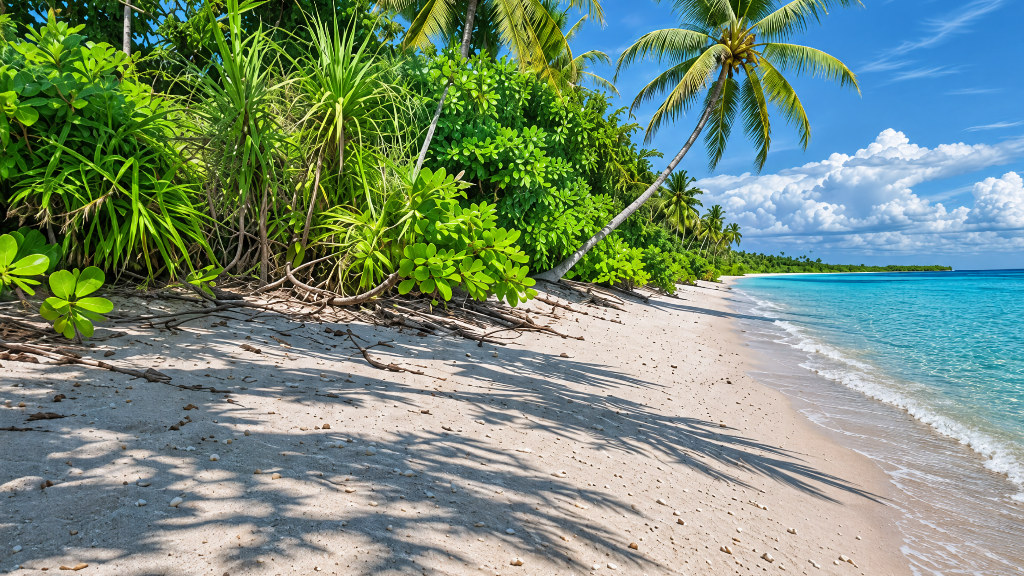
This comparison starts from the same unchanged 1774×887 built-in image. The prompt requested a lagoon-facing center and a clean wrap; the base instead centers palms and has a wrap defect. Those choices were accepted and frozen for this comparison. Enhancement reconstructs plausible detail; it does not recover photographic truth.

Read the exact original prompt
Use case: photorealistic-natural. Asset type: a full spherical immersive skybox source, not a wide-angle photograph. Create one full 360-degree by 180-degree equirectangular panorama in an exact 2:1 canvas, 3840x1920 if supported. A serene Maldives island beach at eye level about 1.5m above fine white sand, looking out over luminous shallow turquoise water toward a clear level Indian Ocean horizon. In the opposite direction, the same beach continues into natural tropical palms and low lush island vegetation. No buildings, people, boats, text or logos. Warm clear midmorning daylight, realistic white sand, delicate small lapping waves, convincing individual palm fronds and natural vegetation. Full 360 longitude, full latitude from zenith to nadir. Camera has zero roll, horizon is perfectly level at exactly vertical center (50% height); beach and water are below center. Equirectangular longitude distortion and strong polar stretching are required; the entire top row is the single blue sky zenith, the entire bottom row the single sandy nadir directly under camera, with natural pole convergence when projected onto a sphere. The left and right borders must join as one continuous scene, with identical sky, horizon, ocean/beach geometry and lighting at the wrap; place the wrap in uncomplicated distant water/sky if possible. One coherent island with geometrically continuous shoreline and a calm comfortable seated-view atmosphere. Sharp detailed natural photographic rendering, restrained color and exposure; no oversharpening, no lens vignette, no collage, no inset views, no frame.GPT Image 2.6 uses API model gpt-image-2.6-sunburst; Nano Banana Pro uses gemini-3-pro-image. Both received the same source bytes. The original two-route figures below put GPT on the left and Nano Banana Pro on the right. The later Nano Banana 2.1 trial reuses that unchanged source.
Restore the whole panorama first
A coherent global restoration comes before fine face detail. GPT returned 3840×1920 at high quality in Standard mode. Nano Banana used cyclic 21:9 context in Standard 4K, returned 6336×2688, and was explicitly unpadded and downsampled to a 5376×2688 panorama. The source stays unchanged.

Six faces, measured native size
Project six approximately 102° faces: a 90° core with 6° context on each side. GPT’s 1186-square inputs returned 2880-square faces; Nano Banana’s 1660-square inputs returned 4096-square faces. The inputs were projected at source density, not enlarged to the requested output size. The successful probe is one of the six faces.
Merge the returned faces directly with a 0.25° blend half-width. Calculate the final 2:1 size from the actual stored-to-core ratio T and returned face side N. This conservative sampling rule describes pixel density, not resolved detail. Neither result is native 12K.
f_center = N / (2*T) pixels per radian
W = 2 * floor(pi*N / (2*T)); H = W/2

GPT:  T=1186/960,  N=2880 → 7322×3661
Nano: T=1660/1344, N=4096 → 10418×5209
These are 512-pixel crops from the native forward faces. Open the image at full size for 1:1 inspection. They cover different angles because the pixel densities differ; the matched-angle comparison below is better for judging the same scenery.
Repair what the images actually show
GPT’s raw merge had sky facets and vertical exposure bands. Local sky-tone matching reduced the facets, and a guarded mask retained coherent global-restoration sky over about one third of the canvas. That area interpolates the 3840×1920 sky rather than adding new 7.3K detail. Two paid 60° perspective edits at yaw ±135° repaired the remaining sky/water join bands.
Nano Banana’s nadir had a radial sand star. The first paid repair failed and still counts in the cost. Local donor-grain healing removed the radial shape; a second paid edit restored grain, localized to protect stones, shadows and overlaps. A local wrap correction reduced the narrow sky seam.

Nano Banana still has a broad sky-tone split at the wrap, converging cirrus at the zenith, and smoother central nadir relief. In these outputs, GPT reconstructed crisper foliage, water and sand; Nano Banana returned more pixels with softer detail. More pixels do not guarantee a better View.


The matched-angle images use the same directions, field of view and 768-pixel review grid. They are perspective resamplings, not extra generated detail. Review covered six directions, all 12 cube-edge views, poles, wrap and repair boundaries. These remain comparison candidates: Locus import, physical Vision Pro appearance and comfort are not verified. The water is painted into a static skybox, with no motion, depth or parallax.
Nano Banana 2.1: a lower-cost follow-up
On November 14, 2026, we tested gemini-nano-banana-2.1 with the same frozen source and original prompt. All nine outputs used Standard mode: one global restoration, six faces and two repairs. G returned 6336×2688, unpadded to 5376×2688; all six faces returned 4096×4096. Native assembly produced 10418×5209, with no forced 12K enlargement.

The raw downward face had a crater and radial sand distortion. R1 was insufficient and remains in the cost. Local donor-grain healing flattened the geometry; R2 restored texture, with protected reinsertion around stones, shadows and shoreline. A small pre-R2 pixel patch removed an invented leaf edge. The local sky-wrap helper reduced a narrow tonal wedge.

In this scene, 2.1 was close to Pro in foliage and water detail, with better wrap continuity and more visible grain in the repaired nadir. GPT’s candidate had crisper reconstructed foliage, water patterns and sand relief. The three routes have different local repairs; one scene does not establish a universal model ranking.

Independent static review covered six directions, 12 joins, wrap, poles and native repair boundaries. Waxy leaves, soft sky, zenith cirrus convergence and lower-relief repaired sand remain. Locus import and physical Vision Pro appearance are not verified. The default model has not changed.
Count the whole job before paying
Count paid outputs as B + G + F + R + E: paid bases, global restorations, faces, repairs and extra attempts. Here B=0, G=1, F=6, R=2, E=0: nine per route. The original two-route run used 18 outputs; the separate 2.1 follow-up adds nine, making 27 across all three. The accepted probe belongs to F6. A rejected repair is still a paid output; further rerolls increase the count.
| Route | Native panorama | Usage-priced USD |
|---|---|---|
| GPT Image 2.6 · Standard | 7322×3661 | $1.614237 |
| Nano Banana Pro · Standard G/R, Batch F6 | 10418×5209 | $1.471502 Residual tokens at text rate $1.587014 Conservative accounting |
| Nano Banana 2.1 · Standard | 10418×5209 | $1.0942455 Residual tokens at text rate $1.1840655 Conservative accounting |
The original GPT/Pro rates and usage are from November 13, 2026. Nano Banana Pro’s $1.471502 assumes unclassified candidate tokens use the text rate; $1.587014 conservatively reserves the token-classification and image-input differences. The original two-model combined conservative accounting is $3.201251. These are response-usage calculations, not reconciled provider invoices or a fixed price for your View.
The 2.1 trial had its own $2 operational cap. Its image-output subtotal was $1.0206; the usage-priced total is $1.0942455 if unclassified candidate tokens use the text rate, or $1.1840655 with those tokens conservatively reserved at the image rate. All nine requests were Standard. Batch is a priced alternative, not an executed 2.1 result. Headset acceptance is still pending.
Nano Banana Pro’s six faces used real asynchronous Batch jobs, including the probe. Batch cuts the image-output fee by 50%, but each job can take about 24 hours, and dependent stages must wait. Choose Standard or Batch before production. Offer GPT Batch only after confirming that exact model, account and endpoint are eligible.
R = approved repair outputs (0..2)
GPT high / Standard image-output subtotal:
  $0.081 + (6+R)*$0.1779 = $1.1484..$1.5042
Nano Standard G/R + Batch F6 image-output subtotal:
  $0.24 + 6*$0.12 + R*$0.24 = $0.96..$1.44
Nano Banana 2.1 Standard image-output subtotal:
  (7+R)*$0.1134 = $0.7938..$1.0206
Nano Banana 2.1 modeled Standard G/R + Batch F6:
  (1+R)*$0.1134 + 6*$0.0567 = $0.4536..$0.6804
Total = image outputs + image/text inputs + text/thinking outputs
The output subtotal is only part of the bill. Use actual response counters for input and thinking charges, keep unknown overhead and any reserve separate, and check current provider prices before quoting a new run. Local projection, merging and reassembly add no image-API fees; agent subscriptions and storage are separate.
Read the full cost formulas and Batch policy · See all 27 request counters
Download, inspect, then import
The delivery JPEGs keep the native dimensions, using quality 95 and 4:4:4 sampling. Download a candidate, save it in iCloud Drive/Locus, and wait until Files on Apple Vision Pro can open it. In Locus, open Places → Import → Import a View → Files, then select the JPEG. Check the wrap, poles, scale and comfort in the headset before accepting your own result.


Download the authoring and review archives
- GPT raw outputs, inputs and prompts · 139.58 MB
- Nano Banana outputs, failed repair and inputs · 197.33 MB
- Perspective reviews and repair masks · 83.38 MB
- Nano Banana 2.1 inputs, native outputs, repairs and counters · 147.11 MB
- Nano Banana 2.1 and three-route review evidence · 169.94 MB
Reassemble saved outputs without new API calls · Check asset sizes and SHA-256 identities
The public skill, scripts and recipes are Apache-2.0; the demo images have separate terms in the repository’s license map.
Free Rooms and selected free Views can be downloaded as examples to study, some with their Blender source. Browse the examples in the Gallery.
Coding agents can read place-examples.json for each download’s URL, size, SHA-256, features and license.